|
|
|
|

Pest alert — Bed Bugs
There has been an increase in consumer awareness about bed bugs during this past year. We want to dedicate this newsletter to talking about this pest; dispelling some myths about bed bugs; some things to consider during this high-traffic holiday season; and home inspection techniques for you to protect yourself.
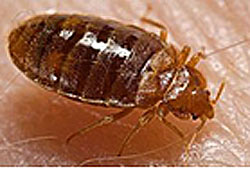 What is a bed bug, and why is this issue coming up now? What is a bed bug, and why is this issue coming up now?
Bed bugs are from the “bug” family of insects, Hemiptera. In particular, they are ectoparisites: a parasite which lives on the outside of the body of the host. Bed bugs were a common problem in the US up through the World War II era. At that time they were virtually eradicated due to wide-scale usage of pesticides that were later banned, such as DDT. Their secretive behavior, coupled with a lack of public awareness has enabled this insect to move very efficiently from one home to another and has facilitated their rapid dispersal across the country.
The resurgence of bed bugs has yet to make as big an impact here in the Pacific Northwest as it has on the East Coast or even other countries, so we want you to be aware and prepared for when you do encounter bed bugs.
How does one “get” bed bugs?
MYTH: Bed bugs are only found in homes that are cluttered and/or dirty. Bed bug infestations are not caused by poor sanitation or by social status. Bugs of any kind do not have the ability to discriminate, and bed bug infestations are found in high-rise hotels, apartment complexes, multi-million dollar mansions as well as homeless shelters – and everything in between. In order for an infestation to begin they must be introduced by bringing bugs from an infested environment and introduced into a previously un-infested one. During the holiday season many of you may be traveling to other homes or possibly hotels, so while you should not panic, you do need to know what to look for.
How do I know if I have bed bugs? What do they look like?
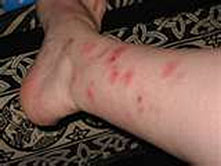
In most cases it will be very obvious that there is a bed bug infestation. As bed bugs feed on blood from a host most often people will have bites on any part of the body that cause itchiniess and swelling.
Adult bed bugs are just under a quarter inch long and are relatively flat. Unfed adults are mahogany to rusty brown; an engorged bed bug is red-brown after feeding. Baby bed bugs (called nymphs) are nearly colorless when they first hatch and become brownish as they mature, but are lighter in color than mature bugs. Nymphs are translucent and no bigger than a pinhead (1mm) so can be very hard to spot.
 MYTH: Bed bugs transmit disease. MYTH: Bed bugs transmit disease.
Although over 28 disease pathogens have been found in bed bugs, transmission of these pathogens to humans has never been documented and is considered highly unlikely. Their medical significance is mainly limited to the itching and inflammation associated with their bite, although not everyone reacts the same way to bed bug bites. You should consult a physician if you are concerned. It is important to note that one cannot diagnose bed bugs from the bite alone – read on for more information of what to look for.
Where should I look for bed bugs?
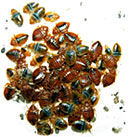
A good starting point is to check the bed area – whether in your home or at a hotel. It is important to realize that the only time that you will see red blood stains is if a bed bug is crushed while it still has an undigested blood meal in its body (similar to squashing a mosquito while it is still full of blood). After feeding bed bugs will digest the blood meal and excrete it as a dark liquid that will appear as dark spots. The dark “spotting” of excreted blood can be found on box springs, mattresses, bed sheets, furniture or any other place that bed bugs are active. If you find what you suspect are bed bugs, try to scoop some uncrushed into a small glass jar or even a plastic “Ziploc” style bag for us to positively identify.
 How can I reduce my exposure to bed bugs? How can I reduce my exposure to bed bugs?
As we stated earlier, bed bugs are always introduced into the home through some means. Travel and the purchase of used or second-hand furniture and/or bedding are still among the most likely ways to introduce bed bugs. Some preventative techniques to consider include avoiding used items and pass up abandoned furniture. When visiting another home during the holidays for a party or function, reconsider putting your coat on the guest bed. Periodically after returning from a trip, check your bed and upholstered furniture. Bed bugs can go undetected for several months until their populations become larger and they eventually emerge in areas where they are more easily detected.
I think I found some in my home. What now? Early detection is key. Infestations left untreated will magnify into very time-intensive and costly treatments, so do not delay in contacting us. Cascade Pest technicians have gone through extensive training on the biology, behavior, identification and treatment of bed bugs. Our new Bed Bug Inspect & Protect program provides a thorough inspection of your home as well as ongoing monitoring systems.
Please refer to our website for more detailed information about this increasingly prevalent pest. We will continue to update this with recent news and information, and in early 2011 will have an online store for home control measures such as travel spray, mattress encasements and more. Most importantly, don’t hesitate to contact us with your questions.
|
|
|
|
|
|
| © 2010 Cascade Pest Control, a div. of Treftz Corporation. All rights reserved. - 2655 151st Place NE, Redmond, WA 98052 |
|